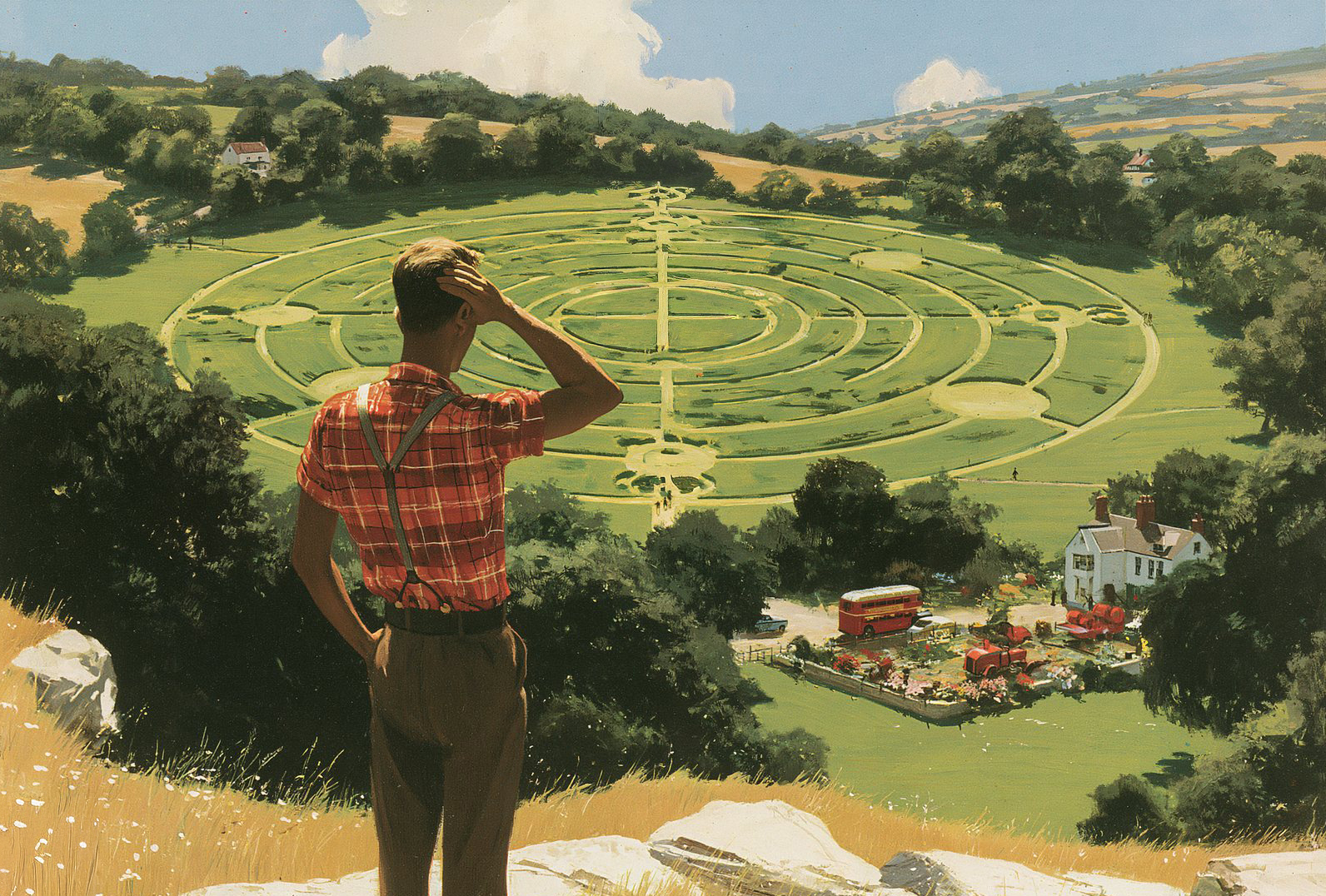
A farmer walks into his field an hour after sunrise and stops at the edge of a geometry that was absent at dusk. The stalks are bent at the first node, unbroken, woven in overlapping layers, still growing; the pattern spans tens of meters and he can read it only in pieces from the ground. His radio carries static inside the perimeter and clears outside it.
Physical trace evidence comprises the material signatures that NHI-attributed activity leaves on the environment. Section 4 catalogs the intelligences and Section 4.5 documents orb and sphere phenomena; the physical traces those activities leave, in crops and in biological specimens, are documented here. Both categories below are heavily contaminated, where genuine cases sit alongside human-made or misidentified ones. The diagnostic weight rests on the physical anomaly profile, which separates the genuine subset from the rest.
Crop Formations
Crop formations represent one of the most publicly visible forms of NHI communication with the human population. They also represent one of the most heavily contaminated evidence categories, due to the significant volume of human-made formations produced over the past several decades. The contamination is acknowledged. The genuine subset remains documentable and distinct.
Distinguishing Characteristics of Genuine Formations
- Biophysical anomalies in affected plants: node elongation, cellular wall changes, and altered germination rates, characteristics consistent with brief intense microwave or directed energy exposure, distinct from mechanical flattening
- Magnetic material in soil samples: fine iron oxide spherules absent from the surrounding soil, consistent with high-energy plasma or electromagnetic discharge
- Appearance speed: credible formations have appeared in timeframes of under twenty minutes, over areas impossible for human teams to cover at that speed and still leave clean ground
- No entry or exit tracks in soft ground surrounding the formation
- Radiation anomalies at some sites; equipment failures reported by investigators during initial entry
What They Are
Genuine crop formations are communications. Addressed to anyone who will read them, the population directly, bypassing institutional mediation. Content categories across the genuine subset:
- Mathematical and geometric communications: formations encoding pi, prime sequences, the Fibonacci series, fractal geometries, and astronomical relationships
- Technical instructions describing geometric principles, field mechanics, or structural configurations
- Narrative sequences appearing over multiple seasons
- Artistic expressions: the equivalent of a signature or greeting
Multiple NHI groups use this communication medium. The plasma and orb phenomena observed at formation sites, balls of light observed entering fields and moving in geometric patterns immediately before formations are found, are consistent with probe-class constructs executing a pre-specified pattern under remote instruction. The medium is chosen because it is visible, persistent, physically measurable, and requires no receiver technology. A radio transmission can be classified or suppressed; a crop formation persists in the open, physical and public.
Formation Mechanics
The biophysical anomalies in genuine formations, node elongation, cellular wall changes, the absence of mechanical damage, become technically coherent when considered against the electromagnetic field capabilities in Section 5. A sphere-configuration craft operating at low altitude with precise charge ring control can direct its field geometry downward at close range with sufficient precision to bend and thermally fix plant stems through field action alone. The node elongation observed in genuine formations is consistent with brief intense directed energy exposure, exactly the effect a charged metallic sphere passing at controlled altitude and speed over plant material would produce. The intricate geometry is a function of field ring manipulation precision and flight path control. The craft touches the plants only through its field. The formation is the field's signature, written in biological material.
Practical Note: If visiting an active formation site, assess it by the physical anomaly criteria above. A formation showing node elongation, magnetic material, and no mechanical damage to the plants is in the genuine category regardless of its apparent complexity. A formation showing broken stems, mechanical flattening, and board marks is human-made regardless of its apparent beauty. Both categories exist, and each should be identified for what it is.
Worked Example. A citizen enters a formation at dawn: stalks bent at the first node and still growing, woven in layered swirls, the stems intact, the wet soil around it unmarked. Node elongation with intact stems and a layered weave is the signature of brief directed-energy exposure, and the clean soil places any night crew elsewhere; magnetic spherules in the soil or equipment faults at the perimeter would corroborate. This sits in the genuine category, and the read holds on the physical anomalies whatever the pattern’s complexity, just as snapped stems, board marks, and trampled ground place a formation in the human-made category whatever its beauty. Document by the criteria, photograph against a scale reference, and sample from inside the pattern and fifty meters out.
Cattle Mutilations
Cattle mutilation events are established globally: livestock carcasses discovered with specific tissues surgically removed, blood absent, no tracks at the site, scavengers avoiding the remains. The two categories described below have different geographic distributions: the human black program category is concentrated in regions with radiological contamination histories, with the highest density of cases in the continental United States correlating with nuclear testing and reactor activity zones. The NHI category is global with no single geographic concentration. The phenomenon has two distinct categories with different operators, different methods, and different purposes. They are consistently conflated because the physical evidence, at first examination, appears similar.
Category One: Human Black Program Sampling
A classified human program for radiological contamination monitoring. Nuclear testing, reactor incidents, and undisclosed radiological accidents contaminate soil, water, and the food chain at levels withheld from public reporting. Cattle distributed across agricultural regions function as biological dosimeters, their tissues accumulate radiological markers at rates that reflect local contamination levels. The program samples these tissues systematically using methods that produce characteristic clean incisions with thermal cauterization. Animals are sometimes removed entirely, sampled elsewhere, and returned, which accounts for the observed absence of tracks at sites where the animal's own tracks disappear within a fixed radius.
Category Two: NHI Blood Transmutation
Certain NHI consume blood through a transmutation process that extracts energetic or biochemical components and converts them into a form of sustenance. The blood is removed entirely through extraction methods that produce no residue, leaving a carcass that appears drained, a presentation distinct from an animal that has bled out. Specific organs removed in NHI cases tend to be those with the highest concentration of the biochemical components of interest, endocrine-rich tissues, reproductive organs with specific hormone profiles, organs involved in blood filtration and production. The scavenger avoidance observed at genuine NHI mutilation sites is consistent with residual field effects from the extraction process.
Distinguishing the Two Categories
- Human program events: precision surgical incisions with thermal cauterization; evidence of tranquilization; helicopter activity in the area; geographic correlation with known radiological contamination zones; sampling pattern focused on tissues with radiological uptake characteristics
- NHI events: complete exsanguination with no blood at scene; no thermal cauterization signature, incisions clean but cold; persistent scavenger avoidance; geographic correlation with NHI activity zones; sampling pattern focused on endocrine and blood-production tissues
Practical Note: If you discover a mutilation event, document it, leave the scene undisturbed, and note which category the evidence profile most closely resembles. Submit through standard channels. See Appendix B.
Anomalous Biological Remains
A third trace category appears at high-permeability sites: the remains of an organism whose form or genetics place it outside the local biological range.
The profile is consistent where it occurs. A carcass is found in terrain that supports no population of the species it resembles. Skeletal features match a form absent from the current catalog. Sequencing assigns a minority of the material to a known related species and leaves the majority unresolved. Decomposition frequently runs at a rate inconsistent with the surrounding environment, and scavenger avoidance appears here as it does at mutilation sites.
The dimensional framework in Section 7 supplies the mechanism. A site where the boundary between layers thins carries traffic in both directions, and an organism that transits and then dies leaves a physical trace of the transit.
Held as reported data: the case data in this category is thin. A single well-sampled find with clean chain of custody would carry more weight than the full volume of accounts currently available.
Practical Note: Photograph in place against a scale reference before touching anything. Sample bone and soft tissue separately, handle through a barrier, and keep samples cold. Note the decomposition state, the insect and scavenger activity present, and the date of discovery. Chain of custody governs the analytical value of everything you collect. Submit through standard channels and state plainly that species identification remains open.
Filamentary Discharge
A fourth trace takes the form of fine filament shed from a craft in flight. It falls as loose strands or a broad web, at times in enough quantity to drape fences, foliage, and open ground across a wide track beneath the path of a craft. The strands are fine, white, and faintly glistening, and they carry a slight tack to the touch.
The diagnostic sits in what the material does next. On the ground, and faster in the hand, the filament thins, contracts, and passes off into the air, leaving little to collect. A sample sealed cold at once holds longest; a strand handled bare is gone within moments. The behavior is consistent with matter drawn together from the air by the craft's field and bound only while that charge holds, releasing back to vapor as the charge bleeds away.
The framework in Section 5 supplies the source. A craft running a high field draws in and ionizes the surrounding air, and a discharge of that charged material trails behind it as a filament that keeps its form only as long as the binding charge remains.
Held as reported data: clean recovery is rare by the nature of the material. A single strand sealed and kept cold, with a clean chain of custody, would carry more than the full volume of accounts of the fall.
Practical Note: Work fast and handle the material as little as you can with bare skin. Photograph it in place against a scale reference, then lift a sample into a sealed, non-reactive container and keep it cold. Note the time of fall, the air temperature, and the track it covers on the ground. State plainly in your report that the material sublimes on handling, so its analytical value rests on speed and cold storage.
The farmer is in the field again at first light, months on, and the geometry under his boots has stopped reading as damage. He still works it carefully, walking the tramlines, noting the layered weave before the wind loosens it, because a thing worth receiving is worth reading closely. What has changed is what he feels standing at the center of it: the pattern was set down by something that knew he would come out and find it, and the knowing runs both ways now. When the first cars slow on the road and the visitors wade in through the standing crop, he watches the marks go under their feet without anger. He has already stood where the message was meant to be stood, and he carries the field’s other language home with him the way you carry a good long look at the stars.