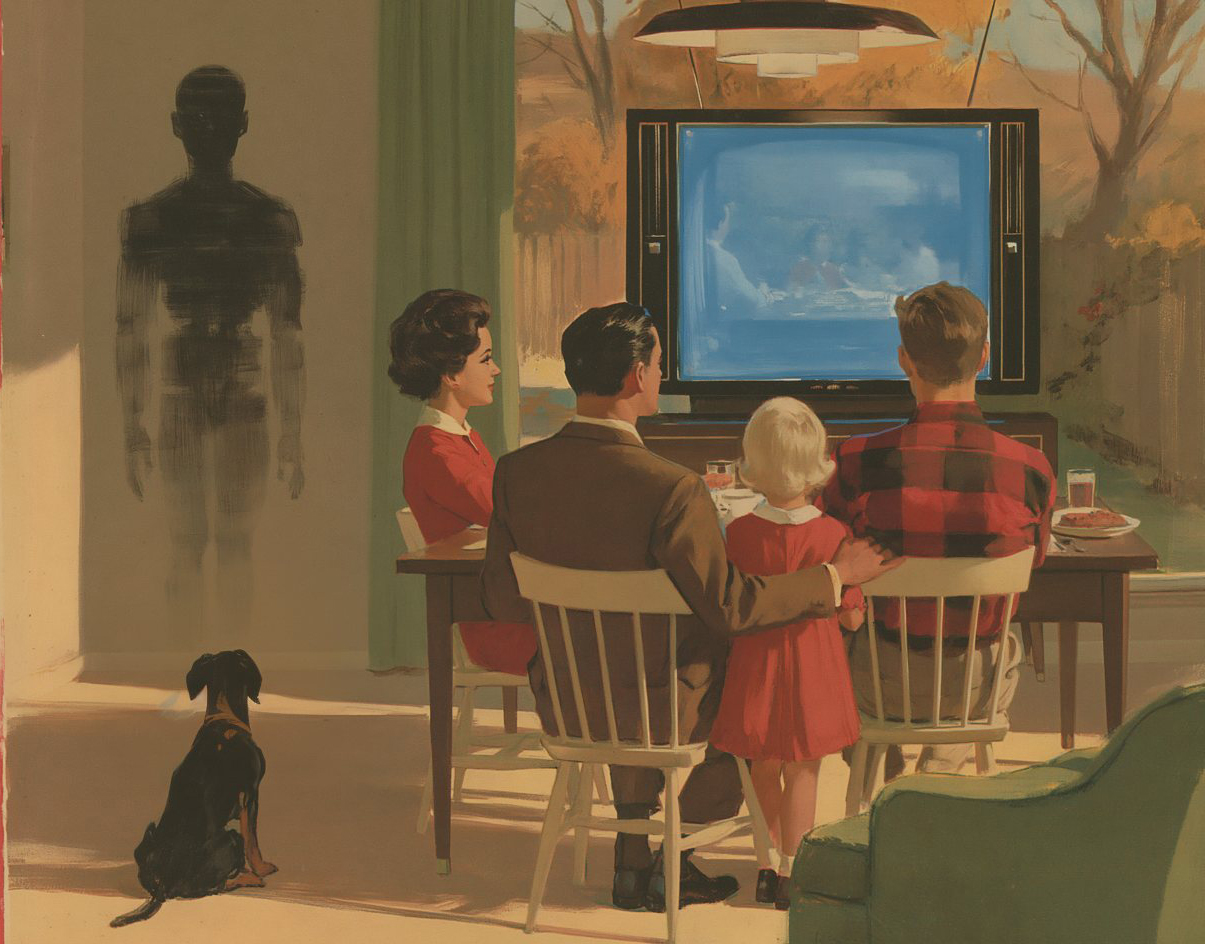
A household sits down to its evening meal. The residents are at the table, and one further party stands beside the coat hooks, where it has stood since the soup. The residents' perception displays a wall. The dog's displays the visitor, and the dog gives it full attention for the length of the meal. Supper concludes on schedule. The arrangement is a common one, and most households that host it finish the evening in good order.
A Populated Environment
Humanity exists within a populated environment. Earth is one inhabited location among many. Human civilization developed without continuous awareness of this fact. The condition holds independent of whether it is recognized. Non-Human Intelligence (NHI) presence on and around Earth predates known human history.
Multispecies Coexistence
Multiple forms of intelligence coexist in, on, and in proximity to Earth. These intelligences vary in origin, biology or lack thereof, dimensional relationship to physical space, and modes of perception and communication.
Multidimensional Overlap
Earth occupies a region where multiple dimensions, probability states, and perceptual layers overlap. Intelligences present on or near Earth vary in their visibility and physical embodiment; many coexist through varying degrees of overlap with physical space.
The variance in what observers perceive, the inconsistency of physical evidence, and the intermittent nature of presence reflect the limits of the observer's interface as much as the nature of what is present. An intelligence that overlaps physical space only in part renders to the interface only in part, and perception completes the rest, filling the remainder with the nearest familiar framework from the observer's own store. Because each observer supplies that completion privately, two people watching the same presence at the same moment assemble different images of it, and a later account drifts further as memory re-completes the gaps. The portion that meets no familiar framework registers as empty space: the interface displays only what it can render, and the rest reaches the observer as the completion their own perception supplies.
Across the universe, intelligence exists predominantly without a fixed physical body. It operates as fields, as patterns of organized information, as awareness coupled loosely to matter or free of it. A biological form bound to one location in space and time is among the more restrictive arrangements a consciousness can take, well suited to a narrow environment and costly to maintain elsewhere. The human citizen occupies that restrictive arrangement and reads it as the normal condition of life, because it is the one condition their interface renders. The wider population of intelligences the citizen is now meeting is drawn largely from the unembodied majority. That is why so much of it overlaps physical space only in part, and why so much of it reaches the citizen as signal and presence more than as solid form.
The Fitness-Truth Gap
Evolution favors organisms that perceive what helps them survive over those that perceive reality accurately. Human perception is the result: an interface tuned over evolutionary time for survival in a narrow environment, showing only what survival required and blind to much of what shares the same space. Subtle energy states, non-physical intelligences, phase-shifted matter, and probability-based phenomena fall outside that calibration.
The computer desktop is the clearest analogy. The icons, folders, and windows on a screen are a world apart from the transistors and electrical signals that constitute the machine. They are a simplified interface. Human perception works on the same principle. The world of objects, colors, and sounds is an interface rendering tuned to that ancestral environment, standing in for an underlying reality far removed from it. The NHI, the dimensional layers, and the non-physical presences fell outside what was fitness-relevant to human survival, and evolution tuned an interface that leaves them out.
The dream gives a second analogy. Inside a dream every test of reality succeeds: the dreamer measures the table, tastes the meal, and examines a leaf under a microscope, and each instrument agrees. The figures in the dream are made of the dreamer. A world can hold up at every scale of inspection and still be made of consciousness, which makes matter one of the forms consciousness takes.
The calibration is measurable in the citizen's own equipment. The visible band is a thin slice of the electromagnetic spectrum; the rest of the spectrum is present in the same room, undisplayed. Hearing spans a narrow band of frequencies; a dog responds to sounds the citizen's interface discards. A bee lands on ultraviolet markings the citizen has walked past, on every flower of their life, without once seeing. The flower carries the markings in plain view; the interface omits them, because reading ultraviolet never fed a human ancestor. The same principle, extended to phenomena farther from the ancestral range, is the operating condition this entire guide corrects for. The separation between what is present and what is perceptible is a property of the observer, and it is adjustable.
Animals are the nearest instruments for checking the calibration. Every species carries an interface tuned to its own ancestral environment, so an animal in the room is an independent reading of the room. Dogs respond to emissions above the citizen's range, to objects behind walls, and to events before any human nearby has noticed them, and some respond while every human in the house sleeps. An animal arrives at the scene with its reaction alone, so that reaction corroborates an observation independent of belief. The emissions animals register are cataloged in Section 5, and the handling of animal responses as evidence is covered in Section 11.
The perceptual filter is loosening, and what it long excluded from the interface is becoming available at scale.
Each citizen now faces the same choice: to do the work of perceiving and engaging with what is here, or to stay within ordinary separated life and the lessons it still offers. Both are real paths forward, equally valid and of equal moral standing. The full structure of why is established in Section 12 — Galactic Lineage: The Developmental Polarity.
Earth's Status
Earth is exceptional in its capacity to host life. It is notable for biological diversity, environmental complexity, and emotional and cognitive variability among its myriad of species. This richness draws sustained attention from other intelligences. That attention follows from Earth's value as a living system; it confers on no party a claim to the planet, a mandate over it, or a place for it at the center of the wider order.
The lineages described in Section 12 have been engaged here since the template era; the recent widening of attention beyond them follows from detection physics. A biosphere is legible at interstellar range through its atmospheric chemistry, and Earth's has read as living for geological ages. The technological signature arrived in a rapid, readable sequence: industrial combustion products in the atmosphere, artificial light spreading across the night hemisphere, then the flash signatures and dispersed isotopes of fission devices. Each marker is detectable at range by instruments modestly beyond current human capability, and each marks a specific developmental condition in the species producing it. The intensification of observation across the recent period tracks that sequence. A species that lights its dark side and splits atoms has announced its condition to every observer equipped to read it; the newer arrivals are the response to the announcement.
Capability and Constraint
Many of the intelligences present around Earth hold capabilities that exceed human technology by margins that place the survival of human civilization within their reach. This capability has been present throughout the span of human development. Human civilization continues on its own terms regardless, because the wider environment operates under a settled framework of conduct norms. The governing principles (free will, sovereignty, and non-interference) establish that a developing species directs its own course, and that capability confers on no party the standing to override it. The capacity to impose an outcome and the right to do so are separate conditions; the framework grants the second to no one. The sustained attention Earth draws operates inside that constraint.
The framework extends to humanity's own capacity for total self-destruction. The capacity to destroy a large share of the planet's biosphere falls outside the scope of legitimate self-determination, because its use would delete a living system whose value reaches well beyond the species holding the weapons. This is the single threshold at which the wider environment acts directly in human affairs. The pattern of strategic weapons systems going offline during craft presence, observed consistently across national nuclear programs, is that constraint in operation; the monitoring is active and responsive. A citizen can hold this as a settled condition: the capacity for civilizational self-destruction exists, and the environment reserves its one standing intervention for exactly that event.
Time and Probability
Intelligences vary in their relationship to time. Many of these beings interact with probability states, future potentials, and parallel outcomes, experiencing time as non-linear. This produces apparent precognition, temporal ambiguity in encounters, impossible speed, and non-sequential interactions, all of which are misread when forced through linear human frameworks.
Why Life Continues
The ambient coexistence of multiple intelligences with human civilization produces far less direct interaction than popular depictions suggest. Most citizens will never have a structured encounter. The minority who do, and the quality of those encounters, are the subject of the sections that follow.
Human institutions, daily routines, personal relationships, and individual goals may remain largely intact in the presence of additional intelligence, and many aspects of human life will hold their familiar shape for the immediate future. That shifts as human perception integrates the new paradigm. Integration places human life within a wider frame, one in which the species' activity and its relationship to the planet are weighed against the stewardship that mature civilizations treat as a baseline. Many citizens, meeting that frame, reassess what they had taken as settled.
Common Early Responses
Citizens encountering this material commonly report a recognizable set of responses, from nervous laughter and an uneasy disbelief to a sense of perceptual destabilization: the feeling that previously reliable frameworks have stopped applying. Alongside this, many citizens reinterpret their own past: events once dismissed or set aside begin to make sense within the framework described here. Trust in official narratives falls in proportion to the weight the citizen had once placed in them.
Emotional responses span a wide range, from wonder to grief. Some citizens report overload. Others report flatness or absence of response. Oscillation between the two is common. Both are functional processing states. In more acute cases, citizens report episodes of acute fear or withdrawal, the nervous system encountering data at the outer edge of its current processing capacity. These responses settle with time.
Practical Summary
- Update your model of reality on the evidence at hand. The environment described in this section is already in effect.
- Treat coexistence as the baseline condition; presence persists whether or not contact is visible.
- When encountering temporal anomalies (missing time, non-sequential recall, precognitive impressions), record accurately before interpreting. Linear frameworks applied to non-linear phenomena produce incomplete conclusions.
- Maintain ordinary routines. Daily life proceeds alongside the presence of additional intelligences.
- Keep awareness distinct from urgency.
Protocol 2.1: The Interface Check
For use when something registers at the edge of perception: a chill, an animal fixed on empty space, a shape at the corner of the eye.
- 1. Hold position. Let the ordinary activity continue around you.
- 2. Count the instruments in the room. An animal fixed on one point, a second person who felt it, and a device that faltered are each an independent reading.
- 3. Record the raw reading first: where, how long, what the body registered, what each observer saw. Write it before discussing it; accounts converge once they are shared.
- 4. Leave the gaps empty. Perception fills a partial rendering with the nearest familiar shape, so mark what was seen apart from what was supplied.
- 5. File it and resume the evening. Repeated readings at one location form a pattern, and the report page takes those.
The household clears the table. The visitor completes its observation and departs by the route it arrived on, which passes through the wall. The dog stands down. Each instrument in the room performed to specification: the residents' perception rendered the portion of the room that kept their ancestors fed, and the dog's rendered a little more. The evening is uneventful.